
Use this diecast construction equipment guide to identify exact excavators, articulated trucks, and wheel loaders by machine, attachment, scale, maker, and item number.
A useful diecast construction equipment guide identifies the full-size machine and the miniature as two related but separate records. Start with equipment maker, machine designation, machine type, fitted attachment, model scale, miniature maker, series, and item number. “Yellow excavator” or “Cat loader” is not enough: similar paint can hide a different machine, attachment package, scale, or collectible release.
The fastest reliable method is to read the model and packaging before judging the shape. Record a designation such as 336, 745, or 950M exactly, but do not confuse it with the miniature maker's item number. Then compare the undercarriage or wheels, body configuration, work tool, moving features, scale, and documented dimensions against an official miniature record.
Why construction-machine identity matters to collectors
Construction equipment is defined by function as much as appearance. Caterpillar's official pages describe the 336 as a large hydraulic excavator, the 745 as a three-axle articulated truck, and the 950M as a wheel loader. Their silhouettes differ because the machines perform different work: an excavator rotates an upper structure and positions a boom, stick, and bucket; an articulated truck carries material in a tipping body; a wheel loader lifts a front-mounted work tool.
Those distinctions become collecting evidence. An excavator's bucket is not interchangeable with a wheel loader's bucket just because both scoop material. A log fork changes a loader release even when the base machine remains the same. Tracks versus tires, an articulated joint, the number of axles, cab location, boom geometry, and fitted tool are all useful checkpoints.
The machine designation is also not the diecast SKU. Caterpillar uses 336, 745, and 950M to identify full-size machine families or models. Diecast Masters uses separate item numbers—85586, 85639, and 85635 for the examples below—to identify the miniature releases. Preserve both fields so a catalog search for the subject does not merge different products.
Three exact construction models to compare
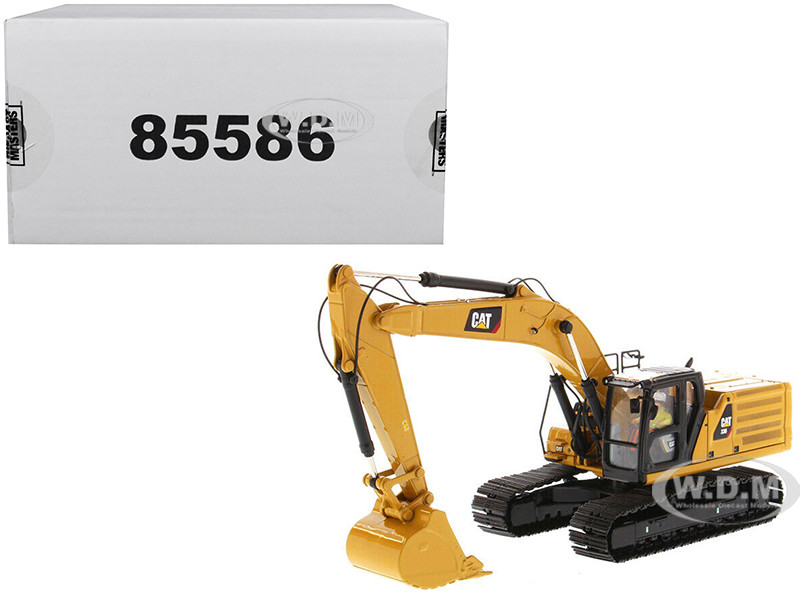
Cat 336 hydraulic excavator — Diecast Masters 85586, 1:50
Diecast Masters' official catalog identifies item 85586 as a 1:50 Cat 336 hydraulic excavator in the Next Generation design. The authorized exact-product record adds the High Line series, an operator figure, metal tracks, 360-degree upper rotation, and a movable boom, stick, and bucket. Those are miniature-specific facts; Caterpillar's full-size 336 page cannot establish them.
The Cat source is still valuable for reading the subject correctly. Its specifications name a reach boom, reach stick, and heavy-duty bucket as separate working-range components. On the model, record all three visible elements and check that pins, cylinders, hoses, tracks, handrails, and the operator are present. A missing bucket or damaged stick is more than a condition note—it changes what can be verified in a loose example.
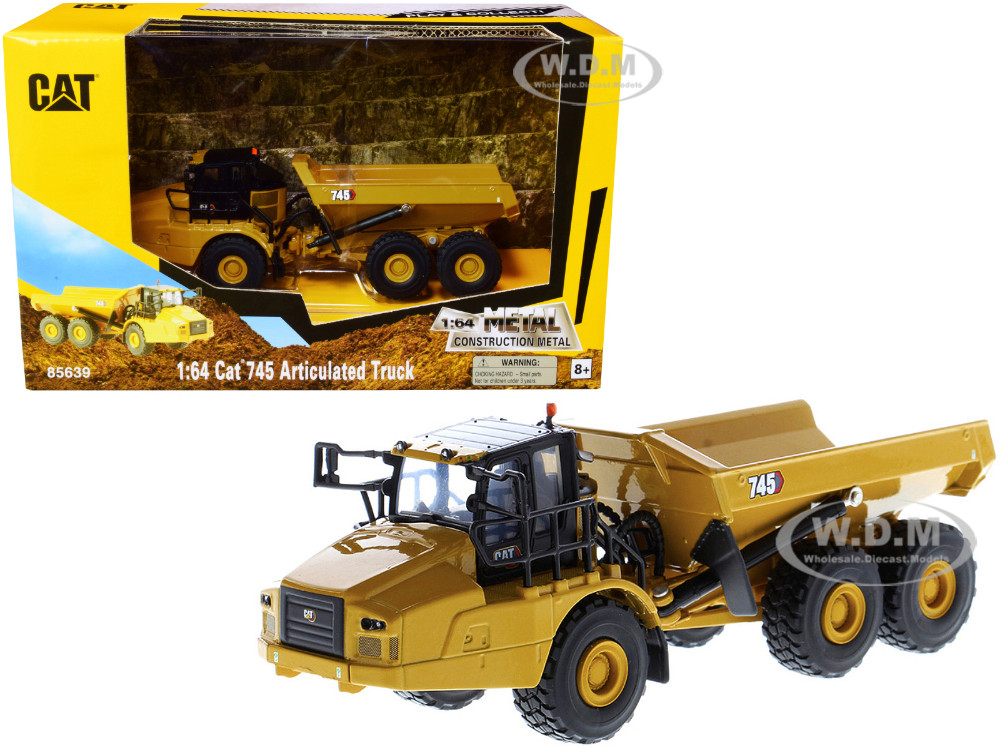
Cat 745 articulated truck — Diecast Masters 85639, 1:64
Diecast Masters identifies item 85639 as a 1:64 Cat 745 articulated truck in its Play & Collect line. The official miniature page lists a functioning dump bed, free-rolling wheels, clear cab windows, and documented dimensions of 6.75 by 2.75 by 2.50 inches. The authorized product record also describes diecast-and-plastic construction and the window-box format.
Caterpillar's full-size page classifies the 745 as a three-axle articulated truck and lists a rated payload and heaped-body capacity. Those real-machine specifications explain why the miniature has a joint between its front tractor section and rear body, six tires, and a tipping body, but they are not the miniature's scale or load rating. Do not turn full-size capacity into a claim about how much the model can carry.
This example also shows why scale belongs beside the item number. A 1:64 745 is a different collectible from Diecast Masters' 1:50 version, even though both represent the same Cat machine. Compare 85639 only with listings and packaging that state the same scale and release identifier.
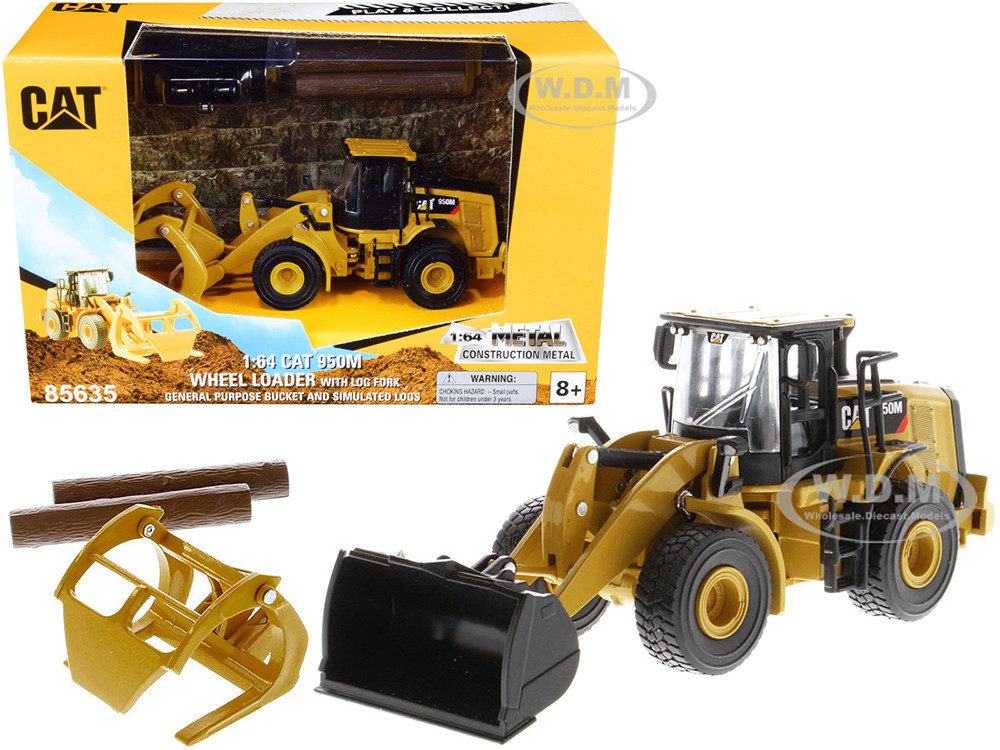
Cat 950M wheel loader with attachments — Diecast Masters 85635, 1:64
Item 85635 is a 1:64 Cat 950M wheel loader supplied with a functioning log fork, a bucket attachment, and two log poles. Diecast Masters' official page also documents articulated steering, a functioning boom, diecast-and-plastic construction, and Play & Collect packaging. Those included tools make 85635 a different release from the plain-bucket 1:64 Cat 950M, item 85692.
Caterpillar's 950M material describes a wheel loader designed for varied worksite jobs, while the miniature maker defines exactly which attachments come in this box. For a loose example, photograph the coupler, fork, bucket, and both poles separately. If one tool is missing, keep 85635 as the likely identity only when the remaining markings and dimensions agree, and record the set as incomplete.
Diecast construction equipment guide: fields to record
- Full-size equipment maker: Copy the licensed brand exactly; do not infer it from yellow paint alone.
- Machine designation and type: Record both “336 hydraulic excavator,” “745 articulated truck,” or “950M wheel loader.” A number without its machine type is easy to misfile.
- Miniature maker and item number: Diecast Masters 85586, 85639, and 85635 identify three specific releases. Keep this separate from the full-size machine number.
- Scale: Preserve the printed ratio. For the same subject, 1:50 is physically larger than 1:64, but actual dimensions also depend on the real machine and the position of booms or bodies.
- Attachment and configuration: Name the fitted bucket, dump body, log fork, blade, ripper, grapple, hammer, or other documented tool. Record spare tools and accessories individually.
- Running gear and articulation: Note tracks or tires, axle count, articulated steering, upper-structure rotation, and moving work equipment without forcing parts past their designed travel.
- Series and packaging: High Line and Play & Collect are different Diecast Masters presentations. Preserve the insert, metal tin, window box, accessories, and instructions when present.
- Condition and completeness: Inspect mirrors, handrails, steps, hoses, cylinders, pins, tracks, tires, couplers, ladders, tools, operator figures, and load pieces.
Source-backed facts at a glance
- Caterpillar identifies the 336 as a large hydraulic excavator and separately specifies its boom, stick, and bucket.
- Diecast Masters item 85586 is a 1:50 Cat 336 Next Generation hydraulic excavator; its authorized release record documents moving digging equipment and an operator.
- Caterpillar identifies the 745 as a three-axle articulated truck with a tipping haul body.
- Diecast Masters item 85639 is a 1:64 Cat 745 with a functioning dump bed.
- Caterpillar identifies the 950M as a wheel loader; that subject identity does not say which tools come with a miniature.
- Diecast Masters item 85635 is a 1:64 Cat 950M set with a log fork, bucket, and two log poles.
- Machine designations 336, 745, and 950M are not interchangeable with miniature item numbers 85586, 85639, and 85635.
- None of the cited records establishes production quantity, rarity, investment value, or current market demand.
A buyer's construction-model checklist
1. Match the full title, equipment maker, machine designation, miniature maker, scale, series, and item number. 2. Compare the undercarriage, axle count, articulation point, cab, counterweight, engine housing, and safety markings. 3. Identify every installed and spare attachment; confirm that all pictured pins, poles, tools, and operator figures are included. 4. Compare stated model dimensions with the boom, bucket, body, and steering in the same position shown by the source. 5. Inspect fragile railings, mirrors, ladders, hydraulic cylinders, hoses, tracks, tires, and couplers in clear photographs. 6. Treat “rare,” “discontinued,” and “limited” as unsupported unless a dated maker source documents the claim. 7. Recheck live price, stock, shipping, taxes, and returns only after the exact release matches.
Browse construction models in the EverythingDiecast catalog, or open one of the exact records pictured above to verify its identifiers and current eligible seller paths.
EverythingDiecast may earn a commission when you buy through eligible retailer links, at no additional cost to you.
Machine specifications, catalog records, prices, availability, and source pages can change. Recheck the linked official and exact-model sources before buying or updating a permanent collection record.
Sources
- Caterpillar: Cat 336 Large Excavator — accessed
- Diecast Masters: 2025 Cat scale-model catalog — item 85586 — accessed
- Caterpillar: Cat 745 three-axle articulated truck — accessed
- Diecast Masters: 1:64 Cat 745 articulated truck — item 85639 — accessed
- Caterpillar: Cat 950M wheel-loader walk-around — accessed
- Diecast Masters: 1:64 Cat 950M with log fork and bucket — item 85635 — accessed
- EverythingDiecast: Diecast Masters Cat 336 — item 85586 — accessed
- EverythingDiecast: Diecast Masters Cat 745 — item 85639 — accessed
- EverythingDiecast: Diecast Masters Cat 950M with log fork — item 85635 — accessed