
Learn why a diecast model's release year and the year of the vehicle it represents belong in separate collection fields, with a source-backed example and verification workflow.
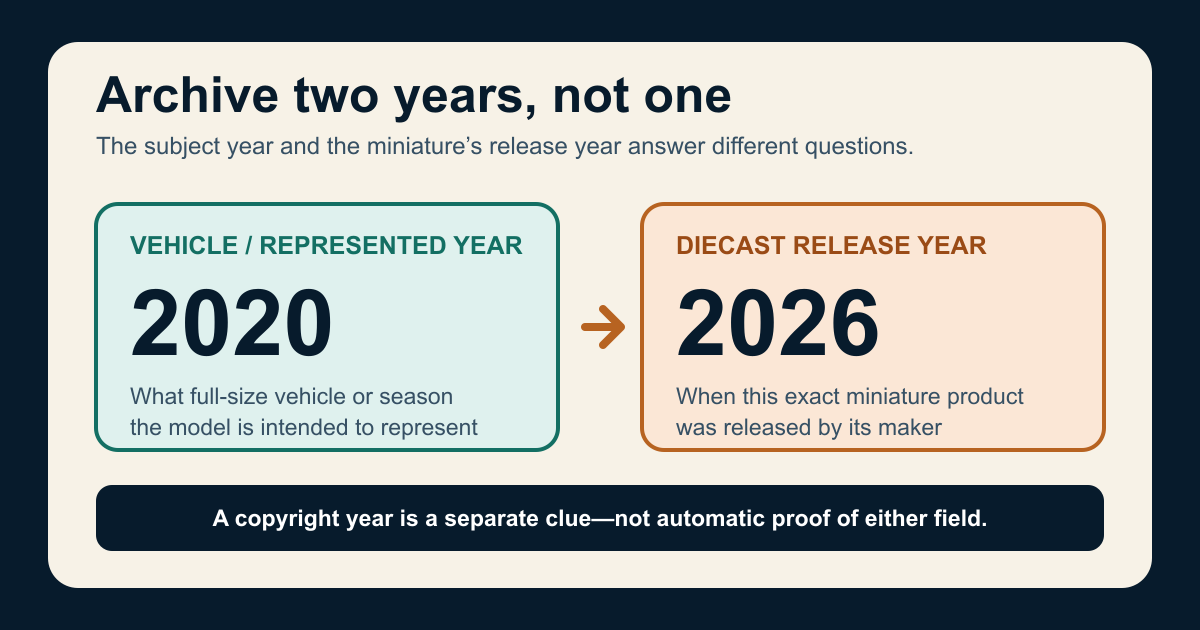
A diecast model can legitimately carry more than one year. The vehicle year describes the full-size subject the miniature is meant to represent; the diecast release year describes when that exact miniature product was released. Store those as separate fields. Do not choose whichever year is easiest to read on the base.
This is not just database tidiness. Two models can represent the same 2020 car but be released years apart, with different product numbers, colors, wheels, scales, or packaging. Combining the two years makes later identification and comparison less reliable.
The short rule
- Represented vehicle year: the year assigned to the full-size vehicle, race entry, season, or configuration reproduced by the model.
- Diecast release year: the year the miniature maker released the exact product or documented release.
- Copyright-notice year: the year stated in an intellectual-property notice. Record it as a clue, not automatically as either year above.
- Manufacturing or package code: evidence about when a particular unit or package was produced, if the maker explains the code. It is not automatically the retail release year.
When a source does not establish one of those fields, leave it unknown. An honest blank is more useful than a confident guess.
A manufacturer record that shows the difference
Mattel's official support record provides a clean example. Its product title is “HW 2020 Lamborghini Sian,” the product number is JKL07, the scale is 1:43, and the separate release field says 2026.
Those values should not be collapsed into one “year” column:
- Maker: Hot Wheels / Mattel — supported by the Mattel product record.
- Product number: JKL07 — shown in Mattel's “Product#” field.
- Represented vehicle label: 2020 Lamborghini Sian — shown in the Mattel product title.
- Diecast release year: 2026 — shown in Mattel's “Released” field.
- Scale: 1:43 — stated in the Mattel product description.
Lamborghini's own dated material adds context for the subject. The company announced the Sián FKP 37 at the IAA on September 10, 2019. That does not override Mattel's 2020 wording; it shows why researchers should preserve the miniature maker's exact represented-year label and keep a note about the full-size vehicle source instead of silently rewriting the record.
The exact product number matters here. A different Sián miniature, scale, color, or package may have a different release year. “I found a Sián from 2026” is not enough to date every Sián casting.
What “vehicle year” should mean in a collection
For an ordinary road car, use the full-size manufacturer's model-year designation when an authoritative source provides it. NHTSA's model-year explanation is useful because it separates that designation from the calendar date when a vehicle was physically produced. A vehicle can belong to a named model year even when production happened in a different calendar year.
For racing models, the represented year may instead come from an official entry list, team record, or race result that identifies the season, event, driver, car number, and configuration. For a historic road car, a manufacturer archive or museum record may be stronger than a later retailer title.
Use a neutral field name such as represented vehicle year because it can cover several evidence-backed meanings without pretending they are identical. Add a note when the source actually says “season,” “event,” “model year,” or “year built.”
What proves a diecast release year
The strongest evidence is release-specific and tied to a stable identifier:
1. a manufacturer product page with a release field and product number; 2. a dated manufacturer catalog or release bulletin naming the exact item; 3. maker documentation that explains a package or production code; 4. a dated authorized distributor record that carries the maker's stable SKU; or 5. a dated retailer record corroborated by a manufacturer or distributor source.
The source must match the exact miniature. Compare maker, product number, scale, series, color, wheels, livery, packaging, and included accessories. If the catalog describes a multipack, do not automatically assign that pack's year to a visually similar single-card release.
A page's copyright footer or “last updated” date does not prove the product release year. It may describe the website, not the model.
Why the year on the base is not enough
A base can carry valuable evidence: maker name, vehicle name, scale, country mark, molded identifier, patent text, or a copyright notice. The error is assigning every visible year the same meaning.
Under U.S. copyright law, a copyright notice on a visually perceptible work can include the year of first publication of that copyrighted work. That legal purpose is different from documenting when every later color, wheel, livery, package, or scale variant reached stores. A maker can reuse protected tooling or artwork across later releases.
Therefore, transcribe a base copyright year exactly as base copyright notice: [year]. Do not promote it to “diecast release year” unless a separate release-specific source supports that conclusion.
The same caution applies to package codes. A code may identify manufacturing time, a packaging revision, a factory, or an internal batch. Decode it only with the maker's own documentation. Collector convention can guide a search, but it is not a substitute for evidence.
A repeatable two-year research workflow
1. Identify the exact miniature first
Record the maker, product or item number, scale, series, color, wheels, livery, and package type. If the model is loose, photograph the entire base and every marking before cleaning or disassembly.
2. Transcribe every year with its label
Write down where each year appears: product title, “Released” field, copyright notice, package code, race-season text, or retailer description. Do not put an unlabeled year into the collection record.
3. Verify the represented subject
Check the full-size manufacturer, official archive, sanctioning body, team, or event record. Record the source's terminology exactly. If the miniature maker's title and the vehicle-history source use different dates, preserve both and explain the difference.
4. Verify the miniature release
Search the maker's complete product number. Match at least one other release-level trait beyond the vehicle name. Save the source URL and access date. If the maker only proves that the product existed by a certain date, record documented by [date] rather than inventing an exact release year.
5. Keep uncertainty visible
Use values such as unknown, not verified, or documented by 2026. A range can be appropriate when dated catalogs establish a first and last known appearance but not a formal release date.
Collection fields worth keeping
A durable record separates facts that are often mixed together:
- represented vehicle year and the source's exact label;
- diecast release year and release-specific source;
- maker product, item, or SKU number;
- casting or base mark as transcribed;
- base copyright notice;
- manufacturing or package code, with decoding source;
- scale, series, color, wheels, livery, and packaging;
- source URL, access date, and uncertainty note; and
- your own uncropped photographs of the model, base, and package.
If you are starting with an unidentified model, use the complete identification workflow. To keep maker item numbers, casting marks, and retail barcodes separate, see the identifier guide. Then search the EverythingDiecast catalog with the complete maker identifier rather than the vehicle name alone.
The collector's final check
Before saving a year, ask one question: What exactly does this source say the year describes? If the answer is the full-size subject, store it as the represented year. If it is the exact miniature release, store it as the diecast release year. If it is a copyright notice, package code, page date, or unverified seller claim, keep it in its own labeled evidence field.
That small discipline prevents one of the most common sources of false precision in diecast records.
EverythingDiecast may earn a commission from eligible retailer links on model pages. This guide itself contains no affiliate links.
Source pages and manufacturer records can change. Recheck the linked primary sources before relying on them for a purchase or permanent catalog record.